





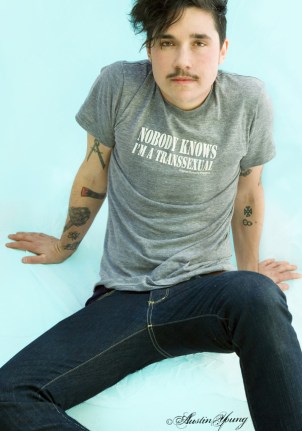
Last fall I needed images for a little (read: life-altering) interview I’d done with Sister Spit. A quick search revealed that every kickass photo of Michelle Tea and Rhiannon Argo that I wanted to use had been shot by the seriously talented Amos Mac. After spending the better part of an hour looking through his photos of people infinitely cooler than me (when I was probably supposed to be writing the intro for that interview), I emailed Amos to request image permissions. Did I think he’d be the most charming / awesome guy I’d never met? Um, no. I was totally unprepared for that.
Not only is he this ridiculously amazing photographer, Amos is also editor-in-chief of Original Plumbing, a magazine dedicated to the sexuality and broad culture of FTM trans guys. I flipped through a copy of OP while perusing the merch table at Sister Spit and it was like being punched in the face with hot, radical sex, and that’s just barely a hyperbole. Amos Mac and Rocco Kayiatos (associate editor of OP and all-around badass) are doing big big things in the world.
So, when you work for an online magazine, you can pretty much talk about whatever you want (I love this job), and I want to talk about Amos Mac! Despite his understandable aversion to being a walking guide to Trans 101, he let me ask some pretty feelingsy questions about what it’s like to be him. He met Margaret Cho, you guys! He’s got sweet hair and cool friends and probably listens to fun music, though I forgot to ask. He’s my Number One Friend Crush, this Amos Mac, and now I’m gonna share him with you.
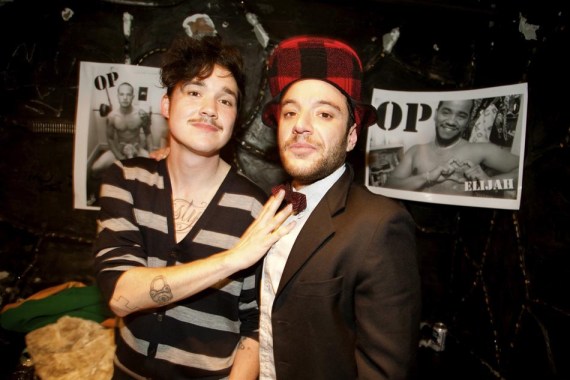
Laneia: I was wondering, is it weird to discuss personal things? Like, probably you just want to talk about Original Plumbing?
Amos: Personal stuff is fine with me. I get sick of answering the same questions about the magazine!
Laneia: Oh good! Especially since this is going to be read by a bunch of feelingsy girls and boys who’ll really want to know about your feeeeelings. Because that’s our #1 feeling (besides our feelings): your feelings.
Amos: Haha, ok! Really, people will care about my feelings?
Laneia: Yes! Like you don’t even know.
Ok, I wanted to ask about when you were a teenager. Seems like having sucky teen years is kind of universal. How did you deal with your body developing? Was it an issue?
I knew I was different from the other girls in my high school, but at that time, the thought of a gender transition never even crossed my mind.
Amos: I dealt with my changing body by wearing larger and larger clothes, until I was literally swimming in my jeans and over-sized t-shirts. Anything to hide the curves. But at that time I didn’t realize why I was dressing that way. I mean, I knew that it was how I felt comfortable and that I was different from the girls in my school, but at that time in my life the thought of a gender transition never even crossed my mind.
My teen years were kind of boring and almost asexual. At that point, I didn’t want to date. I didn’t do normal teen stuff. Like, I obsessed over working at this modern rock radio station in Philadelphia. I got a job there when I was 15 and worked a lot of super late night shifts, like 11 p.m. to 6 a.m. I loved working there.
Laneia: What did you love most about it?
Amos: I think I loved that I was hanging out with adults. And not hanging out with kids my age! The people I worked with treated me like a human being and I felt accepted, which was not how I felt in school. Also, I felt like I had a career.
Laneia: A career in radio! Was it hard to get hired?
Amos: Hilarious to think of now, but it’s all I wanted to do for years! It was weird how it happened, actually. I joined the Girl Scouts for like a month and they had this thing called “Take a Girl to Work Day,” which was basically the only reason why I joined Girl Scouts, so I could participate in this thing! So I signed up and said I wanted to be a radio DJ, and they sent me there for the day, and I hung out with this woman, Lucy St. James, who did all the on-air production for the radio station. We stayed in touch afterward and I called her a year later to ask if I could do anything. I started interning and then eventually I got paid. It was a great experience.
Laneia: This feels like a sort of pedestrian question, but when you think back on things, like being a teenager or a child, do you see that person as a separate person? Or have you always felt the same and the only difference is that now your body matches your mind / heart.
Amos: No, I see myself as the same person. I was just really young and not aware of myself. And not as in touch with myself in my teen years. I think I was more in touch with myself as a young child. But then suppressed it when I felt like it was wrong for me to be male. So the teen years were kind of like, the ‘lost years’ for me.
Laneia: Were you nervous about going on testosterone? Were the results what you’d expected?
Amos: Well I first started T because I just wanted my face to change. I didn’t want to tell anyone about it and I didn’t want my voice to change. I just wanted my body to basically … change. Like, my facial structure. And I didn’t want to have to explain to anyone what I was doing, I wished that it was something that was just happening to my body naturally and that I didn’t have to make some big “coming out” production. I just wanted to be male, a trans man, no questions asked, no need for explanations, you know? It was a very private time.
At first I was only going to take T for a minute and see what happened. Then I just decided to go with it. I can’t remember what made me feel okay with changing all these aspects of my body, but something just switched in my head and I realized that I needed to do this.
Laneia: Did you have a lot of support?
Amos: No. I went to a therapist at the LGBTQ Center in New York City. My friends all knew that I’d identified as male, but I hadn’t told them like, “I am now transitioning and you must now call me by male pronouns, etc.” until I’d already started T. I didn’t really know any transguys, so I went to a trans masculine group every week and met people. I was super separated from the community there because I’d just been in a long relationship with a straight girl.
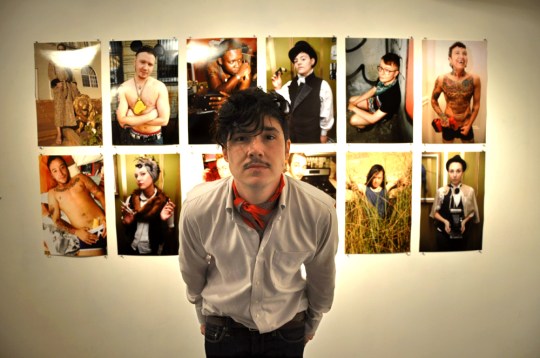
Laneia: Wow. And now you’re doing this magazine. That’s f*cking crazy. Like, how far you’ve come in this relatively short amount of time. Can I ask how you chose your name?
Amos: I liked Amos because it was so weird and old… no one wants that name, it’s literally at an all-time low according to babynames.com! Ha! It means “the bearer of burdens” and a bunch of other random stuff depending on which baby book you pick up, but I didn’t choose Amos for the definition. Mac is short for my middle name, which is Macaulay.
Laneia: Does being called ‘trans’ get old? Would you rather just be referred to as a guy?
Amos: To me being called “trans” isn’t old… I don’t care if people call me trans, male, or a guy, whatever. Getting referred to as a “man” has taken some getting used to. I know that I look like one, but it bugs me. I think because I have a fear of getting older and I wish I could look like a teenage boy for the rest of my life. Or for at least another 20 years. I don’t feel like a man, but I definitely don’t feel like a woman either.
+
NEXT:
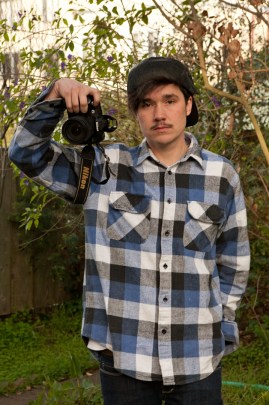
“We call Margaret Cho our “TranMa” (a play on the term Grandma) and she calls us her TranSons.”
Laneia: San Francisco seems like the perfect place to be queer. Is it a utopia, Amos? Should Autostraddle move its headquarters there?
Amos: San Francisco is my favorite city in the entire world. It has this small-town urban feel to it. It’s beautiful, and I’ve found it to be the easiest place for me personally to be a flaming queer, whatever that means. I don’t know if it’s the “perfect” place necessarily. It’s definitely a bubble of beauty, drama, creativity and a city that is very supportive of queer arts. So if you’re into that sort of thing, then yes it’s the perfect place.
That’s not to say that San Francisco is exempt from negative things and issues… It isn’t really a “bubble.” This city experiences things like gay-bash stabbings, trans people being murdered and buried in shallow graves, cops “accidentally” shooting innocent people of color, AIDS, homelessness…it just so happens that this is all going down in a beautiful city that is highly concentrated with gay, lesbian, queer and trans people.
Laneia: Tell me about Issue 2 of Original Plumbing. You have Margaret Cho! What was it like to work with her? On a scale of 1 – 10, 1 being you LOVE her and 10 being you LOOOOVE HER, where would you rank your feelings for Margaret Cho?
Amos: Issue 2 is fucking amazing, Rocco and I are so proud of it. I have a much different relationship to this issue compared to the first one. With “The Bedroom Issue” it felt like a very solitary project, where I didn’t really know what direction the magazine would go in or what the reaction would be from the trans community, as well as the other communities. On a personal note, “The Hair Issue” feels like more of a creative partnership between Rocco Kayiatos and myself, which is a great feeling. The magazine is experiencing growth, which adds so much more to the voices and the finished product.
“Some guys who haven’t had top surgery find it important to show that trans men don’t always have scars to show off, that surgery doesn’t necessarily ‘make the man.’”
It was a blast working with Margaret. She is hilarious, warm, wonderful! Rocco and I had met her in October when we were asked to be part of the music video she was directing for the band GIRLYMAN. Margaret wanted the video to consist of queers, trans people, femmes and butches, as the song, “Young James Dean,” is about butch identity, so her vision was to get as many different types of queers as possible in the video. Rocco and I really bonded with her while shooting it. We just really clicked as friends. Now we call her our “TranMa” (a play on the term Grandma) and she calls us her TranSons. She loves OP and as she is an incredibly outspoken person, she was easy to interview and of course fun to photograph.
Laneia: I loved that video! Also, after watching The Bedroom Interview with you and Rocco, I was ready to tackle both of you with hugs and feathers.
Amos: OMG hahaha. Every time I see a video with Rocco and I together I’m blown away because Rocco’s just so butch! I’m always amazed at how manly he is.
Laneia: But I bet he’d like the feathers. Who the f*ck doesn’t like feathers?
Amos: Yes it’s true!
+
Laneia: You’ve said that part of the purpose of OP is to educate people about trans experiences and take steps forward in trans male culture. With two issues under your belt, has your original vision changed or expanded? Where do you hope to see the magazine in the future?
Amos: OP will continue to grow and document trans male culture, but it’s much more than a magazine. I honestly see the Original Plumbing growing as the community expands and creating culture while we document it. Rocco and I are planning some tours where we’ll visit LGBT youth centers in various towns and hang out, then throw release parties in other towns.
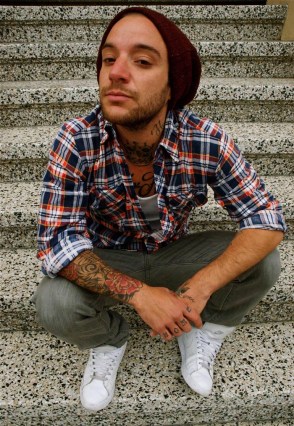
It’s important for us to leave San Francisco and connect with trans guys all over the place because, I mean, for guys in, say, middle America, their lives are often isolated, and they are left without a voice. It’s something that I really want to document and share.
Laneia: How did you get started in photography?
Amos: I can’t remember when I started taking photographs. I can remember stealing my moms camera and playing around with it from a very young age and always finding importance in the photographic image, being obsessed with memories and wanting constant visual reminders of where I’ve been and who I was surrounding myself with.
Laneia: What camera do you use?
I shoot with a digital SLR — a Nikon D70s and whatever lens it came with, I don’t even know. Sometimes I play with a wide angle lens, but usually it’s pretty straight forward, with natural light. The camera has a huge crack going down the center of it from when I dropped it down one of the steepest hills in San Francisco a couple years ago. I had to replace the flash but the rest remains intact. I’m not much of a camera equipment snob, and I’m kind of rough with most of it, throwing it into bags wrapped up in winter scarves instead of in a camera bag, stuff like that.
Laneia: What are you looking for when you’re choosing models for Original Plumbing?
Amos: It depends on how I’m feeling that day. When I choose models for OP, sometimes I’m looking for a person with an interesting story, sometimes I want someone that has history in the community, or sometimes I want someone I happened to meet that day that has no interest in modeling for me or even sharing their story! It’s truly a random mix.
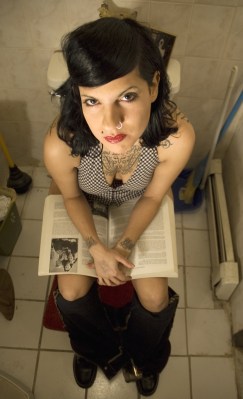
Laneia: What was your most memorable photo shoot?
Amos: Probably a toss up between shooting Cristy Road sitting on the toilet reading “Our Bodies, Ourselves” and the shoot I did with Brontez where he dropped his pants and ran around the Eagle in San Francisco with a creamsicle early one Saturday afternoon. Both of these stand out in my mind because they were shoots I went into feeling slightly unsure as to how I wanted to capture these people so I just had a blank slate of a brain and started shooting. The final images just exude personality in a way that could have never been planned or forced. This is of course due to the amazing nature of the models, their ability to be spontaneous and insane and cause a scene while I follow them snapping away.
Laneia: You’ve mentioned that a lot of these guys want to show off their scars. What do you think being published in OP means to your models, on a personal level?
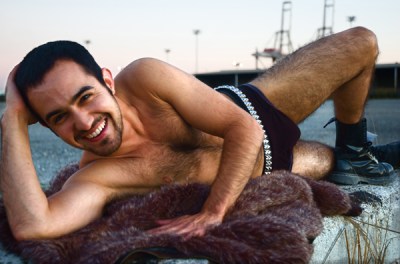
Amos: I feel like our models are excited to be in a publication where they are representing themselves. And yes I’ve said in the past that they are proud of their scars, but there are also guys that are proud to show off their bodies without scars. I’m referring to guys who haven’t had top surgery, who find it important to show that trans men don’t always have scars to show off, that it doesn’t necessarily “make the man” to get any sort of surgery.
I’ve had some haters, and they always say they cant believe I’d publish trans bodies the way that I do. Like I’m doing something wrong by sharing it with people in the world. Clearly they don’t see the power that the photos have, the strength and happiness and self esteem it can effect, in like young trans or questioning people or anyone who feels ‘different’ in their body
Laneia: RIGHT. That’s what I love so much about what you’re doing! Are there any projects or collaborations we can look forward to?
Amos: Fuck yeah! Michelle Tea’s book “Valencia” is coming to life in movie form, and each chapter is being cast and filmed by a different artist. It’s kind of an epic project and I have no idea when it will be finished or released, but I’m filming a chapter. That’ll keep me busy this summer.
Get more Amos Mac’s photography at his website, Amos Mac Dot Com.


Comments
This is an amazing interview!!
1. Amos is so cute! Eeek!
2. I want to check out OP. Note to self!
3. I only recently stopped wrapping my new camera in a winter hat, so I’m glad to hear about how Amos treats his nice things too.
4. “Michelle Tea’s book “Valencia” is coming to life in movie form, and each chapter is being cast and filmed by a different artist.”
WHAT! I didn’t know that. Good lord, I love her. Everyone go read “Rent Girl.” Now.
5. I’d be curious to know what Amos thinks about Catherine Opie, the photographer.
re 2- I have issue 1 and it is very cool.
re 4- I think Valencia is my fav MT book (although I haven’t finished Rent Girl Yet.)
It’s a really cool magazine! I’m glad it’s getting some press.
hey taylor. i really appreciate catherine opie’s photographs! i was just given a huge book of her work for my birthday this year!
i have that book too! (assuming it’s the big retrospective)…i caught her exhibit at the guggenheim a little while ago and my gf bought if for me! i just pulled it out actually and will place it firmly on my coffee table. it’s interesting (at a glance- I want to see more of your work!) how differently you both capture similar subject material, on the gender front at least. her style is so hard to pin down though, it’s kind of crazy. like ice houses vs. the masochistic self-portraits and whatnot. interesting!
Especially since this is going to be read by a bunch of feelingsy girls and boys who’ll really want to know about your feeeeelings. Because that’s our #1 feeling (besides our feelings): your feelings.
This is the best synopsis of AS ever on earth or for all of space-time.
also, thank you amos for being unpretentious about your equipment and giving hope to some of us kind of broke little lesbians toting kinda old, not amazing cameras around! i like that his cam has a crack. one of mine had a light leak and i still insist on taping it over instead of getting it repaired. it just feels right-er!
his total lack of camera snobbery kinda made my day.
this is an amazing amazing interview, and amos mac is definitely deep into friend crush territory now. his photos are so wonderful! and i feel like our culture/community so often forgets that FTM trans guys exist, i am super excited about OP now!
i agree! so insightful!
that’s a nice hobbes!
thank you! that’s a nice taylor!
thanks!
i just wanted to say that i have some feelings re: how ppl ‘forget’ or don’t think about the trans community, which i will explore laterrr, hopefully. maybe with help! xox
i love ‘feelings’!
<3 this one ^^^
I love this interview and my love for the SF Bay Area continues to swell.
The film version of Valencia is officially the movie I am looking most forward to, even more than the new alice in wonderland.
let’s go to SF and make our own, less dysfunctional (maybe?) Valencia inspired reality show! Or just live there. Yeah.
i support this.
Augh! No Sydney based distributor! T_T Maybe I’ll order one, if only just to get even weirder looks than usual on the train. ;)
If I saw you reading OP on a Sydney train then I would most definitely walk over and high five you.
Great interview! Wonderful photos too.
We will hopefully be sold in Sydney soon! We were just picked up by a distributor that sells a lot internationally, called “Bookazine”, so tell your queer bookstores they can order it from that catalogue any day now.
I could not be more pumped about this interview! Amos seems really awesome, and the photos are great. I’m so jeals of everyone who gets to be in SF every day.
I’m gonna go order an issue of OP now…
Wow, this interview is great! I really liked all of the questions you asked.
amos seems amazing, and he’s totally hot.
I’ve read issue 1 of OP, it was quite cool, i’m excited about the second issue.
Thanks for another great interview, autostraddle. you have established yourself firmly as my favorite blog/website.
thanks amanda!
You guys! This was really an awesome interview. I love everything about it. Checked out Amos’ site. The photography & stories are fantastic.
Also, since everyone is on the San Francisco kick.. I have been there a few times and LOVE it. I know its a completely different experience when you live there, but I hope to some day.
sfsfsfsf!
such a cool interview. i sorta have a crush now on Amos.. but all i can thnink of when i see his name is that mouse named amos in some disney movie?
annnnd my sis is moving to SF this summer and I can’t wait to visit/crash at her apartment for half of the year!
[…] embodied the simple idea if “life” in photos. Amos recently did a HUGE interview with AutoStraddle.com and gave details about life, photography, and what it means to be a transgender man. Visit the […]
Laneia! This interview is so good! I love how you’re so honest, it makes me feel like we’re getting honest answers from Amos, which obviously is super awesome.
Also, his photography is SO FUCKING GOOD OMG
i want to hug this interview and these comments and also that photo of Amos & Rocco on page 1!
in case you guys are interested, and i feel you might be, Amos’s work can also be found in Issue 2 of Cutter Photozine!
and probs like a ton of other places that i don’t know about AND ALSO if you follow @ftmquarterly on the twitter machine, you can keep up with OP’s release parties, etc.! sometimes they’re in L.A., which is still not Phoenix, sadly.
love his photos!
Awesome article. I just recently saw “Young James Dean,” and really loved it. Great interview! Loved it!
I loved this. And I’m happy that y’all brought “Original Plumbing” magazine to my attention/knowledge. I think it’s super cool and is very important to have out there. Lots of luck to Amos on that – I hope it gets the wider distribution it deserves!
[…] An interview with Amos Mac an article on a website Amos Mac is a trans photographer who focuses on the genderqueer and trans communities and who has an ftm magazine and website called Original Plumbing. The ‘girl-on-girl’ culture web magazine that I intern at, Autostraddle, did a great write up and interview with Amos. […]
This interview IS a motherfucking basket of kittens. NOM.
[…] a lot of press in both gay and straight media – some articles have been awesome (the Autostraddle interview comes to mind), and others have been borderline clueless. Have you changed in how you deal with the […]
i’d marry rocco asap and i don0t want to ger married.
Article with a deep knowledge and well-staged. I have visited your website. It is very interesting and impressive. Thanks for sharing with us such a great article. I want to come again. Please update.
vin lookup